Saturday, December 16, 2017

Friday, October 6, 2017
Book Review: Creation by Gore Vidal (1981)

Though “epic” may be the technically correct term (in that
it is Homeric in its scope), the word does not do justice to Gore Vidal’s
spectacular and monumental novel Creation. Set primarily in ancient Persia during the
reigns of Darius, Xerxes, and Artaxerxes, Creation
combines the scale and vision of Homer’s Odyssey
with the intimacy of Pearl S. Buck’s The
Good Earth. The narrative is
presented as the autobiography of Cyrus Spitama, half-Persian, half-Greek, grandson
of the prophet Zoroaster and bosom friend of the Crown Prince and future Great
King, Xerxes. It spans his long life,
from his birth in a Zoroastrian cult, through his entry into the Persian court,
his ambassadorships to India, China, and Greece, and finally his death at
seventy-five.
Classical literature often has a distinctly foreign feel,
but Vidal makes the ancient world seem real and near as few authors have done. He writes not as a modern man looking at this
2500-year-old culture through a modern lens, but as a Persian noble for whom
this setting was modern. Cyrus is unburdened by the baggage of Western
cultural norms and Vidal’s knowledge of future history, giving the reader the
distinct and rare sensation of exploring the ancient world as a native, rather
than a tourist.
During his travels, Cyrus meets figures such as the Buddha, Confucius,
Lao Tsu, and Socrates (he doesn’t find the latter particularly impressive); he
visits the hanging gardens of Babylon, where he watches the teenaged Xerxes
seduce an adolescent temple priestess; he is married to a 12-year-old Indian
princess; and he is kidnapped and sold into slavery in China. His journey spans nearly the entirety of the
known world, and he reflects on each adventure with a mix of dry humor, the
detachment that comes with the passing of decades, and the nostalgia of old
age.
Creation is no
light undertaking (my paperback copy is nearly 600 pages of seemingly
microscopic font), yet as I neared its end, I found myself dreading the
inevitable farewell to Cyrus and his devoted stenographer Democritus. Like the end of a long and full vacation in a
foreign country, I wished I had time to see just one more sight, meet just one
more character. Barring that, I plan to
dive deeper into Vidal’s body of work; if his other novels are half as engaging
as Creation, it will be time well
spent.
Wednesday, August 23, 2017
Book Review: How We Got to Now by Steven Johnson (2014)
 Steven Johnson’s How
We Got to Now: Six Innovations That Made the Modern World tells the stories
behind technological developments that impacted the day-to-day lives of
ordinary people in ways so unforeseeable that, in hindsight, they’re almost shocking. The flash bulb, for example—originally
invented to enable photography inside lightless Egyptian tombs—finally gave
journalist Jacob Riis the tool he needed to bring the horrifying conditions of
New York City’s tenement slums into the public eye in a way that words and line
drawings could never do, resulting in sweeping legislative reforms and, according
to Johnson, “ignit[ing] a new tradition of muckraking that would ultimately
improve the working conditions of factory floors too… chang[ing] the map of
urban centers around the world.”
Steven Johnson’s How
We Got to Now: Six Innovations That Made the Modern World tells the stories
behind technological developments that impacted the day-to-day lives of
ordinary people in ways so unforeseeable that, in hindsight, they’re almost shocking. The flash bulb, for example—originally
invented to enable photography inside lightless Egyptian tombs—finally gave
journalist Jacob Riis the tool he needed to bring the horrifying conditions of
New York City’s tenement slums into the public eye in a way that words and line
drawings could never do, resulting in sweeping legislative reforms and, according
to Johnson, “ignit[ing] a new tradition of muckraking that would ultimately
improve the working conditions of factory floors too… chang[ing] the map of
urban centers around the world.”
In a similar vein, Johnson shows, the invention of the
printing press and the spread of literacy in the western world brought to light
(somewhat literally) a surprising new problem: the prevalence of
near-sightedness. This led to a sudden
demand for corrective lenses, which in turn prompted a surge in glass- and
lens-making technology, which then rapidly gave rise to both telescopes and
microscopes. During the Renaissance and
the Industrial Revolution, these developments had a profound effect on
scientific discovery, leading to such momentous events as the discovery of
germs and the widespread acceptance of a heliocentric solar system. Gutenberg would never have seen it coming.
Johnson calls these processes the “hummingbird effect,”
noting that when examining the evolution of pollen, almost no one would predict
that it would eventually result in the development of the hummingbird’s wing,
which rotates differently from any other bird’s, allowing it to hover in
mid-air while it feeds on flower nectar.
The stories that Johnson tells in his six densely-packed
chapters are fascinating, well-sourced (the bibliography is stacked with both
primary and secondary sources), and relevant; any modern reader can easily draw
connections between the innovations Johnson explores and their own life. Fans of historical nonfiction or good science
writing will find the book both interesting and informative.
I offer two minor critiques here—one of style, and one of
substance.
Regarding style, though Johnson’s tone is both erudite and
readable, he waxes rather pedantic from time to time. Rather than allowing the reader to speculate
on their own about the implications of a particular point, Johnson prefers to
spell it out for them, occasionally drifting into aphorism. “Ideas trickle out of science, into the flow
of commerce, where they drift into the less predictable eddies of art and
philosophy,” he writes. This sentence is
vague enough that it could be cut and pasted onto practically any page of the
book; it happens to appear in the chapter “Light.” He also tends to repeat his main idea more
often than necessary—the theme of the book is innovations that led to
far-reaching and unpredictable consequences, and he is determined that you
won’t forget it. Also in the chapter
“Light,” he writes, “Here again we see the strange leaps of the hummingbird’s
wing at play in social history, new inventions leading to consequences their
creators never dreamed of.” “Light,”
incidentally, is the final chapter; it would be reasonable for Johnson to
assume that the reader has gotten his point by now.
Regarding substance, Johnson acknowledges in his
introduction that he is focusing exclusively on innovations from North America
and Europe, because, he says, “certain critical experiences—the rise of the
scientific method, industrialization—happened in Europe first, and have now spread across the world.” But this brand of western exceptionalism is
disingenuous. Johnson chose to examine technologies that were
first developed in Europe; to ignore technologies developed in other cultures
and pretend that Europe’s innovations alone were somehow more far-reaching or significant
is myopic and inaccurate. The flash bulb
illuminated New York’s slums and led to worldwide social reform, but the
gunpowder which made the first flash bulb possible was invented in China nearly
a thousand years earlier, and one could just as easily trace those social
reforms back to it, rather than stopping at the flash bulb.
Likewise, BBC writer Tim Harford points out that the
revolution brought on by Gutenberg’s press would have been impossible without
another Chinese invention: paper. And one
could trace these innovations even further back to the development of written
language itself, which was probably invented independently by more than one
culture, including ancient Mesopotamia around 3500 B.C.E. Johnson chooses to focus solely on western
inventions—that’s his prerogative as a writer.
But to imply that western culture is somehow special or ahead of the
curve when it comes to technological innovations that shaped modern life is
misleading.
That said, Johnson endows his narratives with detail,
robustness, and occasionally humor, making How
We Got to Now an engaging, informative, and fun read.
Sunday, August 13, 2017
Implicit Bias and the Usual RAVs
 This is Daniel Brühl.
If you are an American movie-goer, you might know him from his role as
the villain Zemo in Captain America:
Civil War (2016), or as the charming but dangerous Nazi officer in The Zookeeper’s Wife (2017), or as the
charming but dangerous Nazi soldier in Inglourious
Basterds (2009).
This is Daniel Brühl.
If you are an American movie-goer, you might know him from his role as
the villain Zemo in Captain America:
Civil War (2016), or as the charming but dangerous Nazi officer in The Zookeeper’s Wife (2017), or as the
charming but dangerous Nazi soldier in Inglourious
Basterds (2009).
On the other hand, if you are a German movie-goer, you
probably know Brühl as the sweet and devoted son in Good Bye Lenin! (2003), or as the ambitious journalist in the
absurdist comedy/drama Me and Kaminski
(2015).
Brühl was born in Spain and grew up in Germany, and though
he speaks six languages fluently, he speaks them all with a German accent. Heroes with German accents are about as
common in American film as unicorns are on the streets of Kansas City—that is
to say, they don’t exist. Brühl might be
handsome, funny, likeable, and talented, but he’s a native speaker of German,
and though his English is flawless, his accent is unmistakable. As a result, he is and probably always will
be the villain in American culture. (This,
of course, despite the fact that Germany is currently one of the U.S.’s
strongest allies.)
In a similar vein, Rob Lowe’s character in Thank You For Smoking (2005) comments
that in modern American movies, the only people who smoke are “the usual
RAVs... Russians, Arabs, and villains.”
This comment is a bit redundant, however, since Russians and Arabs
nearly always are villains in these
films. Lowe’s character should have said
“RAGs”—Russians, Arabs, and Germans—knowing the audience would automatically associate
these groups with movie villains anyway.
The reasons that these groups are still consistently
depicted as evil in American film are myriad and too complex to delve into here. Instead, I want to discuss the potential
effects of these depictions.
Many, perhaps most, modern movie fans would agree that it is
important for both children and adults to see women, people of color, and other
marginalized groups in leadership and hero roles. Wonder
Woman (2017) has been acclaimed partly for this reason. Seeing women exclusively in secondary or
submissive roles; seeing Black men exclusively in predatory or other
stereotypical roles; seeing women of color not represented on the screen at
all—these patterns reinforce implicit biases already instilled in us by our
culture.
The researchers at Project Implicit at Harvard University write that “Implicit preferences for majority groups (e.g., White people) are
likely common because of strong negative associations with Black people in
American society. There is a long
history of racial discrimination in the United States, and Black people are
often portrayed negatively in culture and mass media.”
If negative portrayals of Black people in the media
contribute to implicit biases, then it stands to reason that consistently
negative portrayals of people with specific non-English accents would have a
similar effect. For example, if a large
portion of Americans hear German, Russian, and Arabic accents only or primarily
in the movie theater or in fictional TV series, and those accents belong almost
exclusively to villains, an implicit association is likely to be created and/or
reinforced.
Of course, German and Russian people do not typically
experience serious discrimination or marginalization within American society
(though refugees and other immigrants of Arabic and Middle Eastern descent most
certainly do), so why is this a problem?
Here’s one reason: News outlets and other media typically
use words such as “Russia” and “Germany” as metonyms; for example, “Russia
invaded Crimea.” In this headline,
“Russia” means the Russian military, or might even refer to Putin’s order to
invade; it does not imply that the entire country of Russia moved wholesale
into the Crimean peninsula.
Yet news outlets on all sides—left-leaning, right-leaning,
and centrist—frequently conflate the will of a group of citizens with the
actions of its government, overlooking the obvious fact that not all citizens
(often, not even a majority) agree with those actions. In both mainstream and non-mainstream media, “Russia”
should not be equated with “the
Russian people” or even “the majority of the Russian people,” and yet it
consistently is.
The current rhetoric regarding North Korea provides an even
more poignant example. Americans are
certainly justified in their fears of a nuclear attack, yet commentators across
the board ignore the point that a war between the two countries would have a
far more devastating effect on the citizens of North Korea, who by and large
are pawns and victims of their leader’s sociopathic decision making. When news outlets discuss “North Korea,” they
mean Kim Jong Un and his government; they largely ignore the millions of
powerless citizens who are subject to his whims.
Hollywood encourages American audiences to view other
nations as monoliths—all Germans are Nazis; all Middle Eastern people are
terrorists; all French people are hypersexualized; all Brits are humorless and polite. These stereotypes may not have the same kinds
of immediate, at-home effects as stereotypes about American people of color and
women, but they are two sides of the same coin.
They are tired, outdated tropes that discourage critical thinking and
promote prejudice, discrimination, nationalism, and myopia. If it is healthy to see American women and
people of color in hero and leadership roles, then we should demand the same of
actors with commonly stereotyped nationalities and foreign accents, including
the talented Mr. Brühl.
Friday, May 12, 2017
Book Review: After Alice by Gregory Maguire (2015)
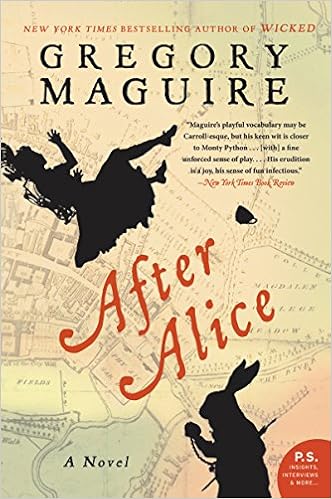 After my last review, in which I recommended that you opt
for anything written by Gregory Maguire rather than Daniel Levine’s Hyde, I feel a bit hypocritical, because
I found After Alice to be
surprisingly mediocre. In his previous
works, such as the Wicked series and Confessions of an Ugly Stepsister (his
retelling of the Cinderella tale), Maguire uses well-known stories as
scaffolds, as frameworks, and around them he builds rich and fantastical worlds
with new characters, details, and perspectives that both fit within and enhance
the original narratives. After Alice, on the other hand, is less
an expansion of Lewis Carroll’s Wonderland
and Looking Glass and more a
rehashing of them. In it, a second
child, Ada Boyce, follows Alice down the rabbit hole and traces her path
through Wonderland, meeting the same characters and, in some cases, having nearly
the same conversations. Maguire is
successful in imitating Carroll’s absurdist style of dialogue, but there’s very
little that’s original in this portion of the story.
After my last review, in which I recommended that you opt
for anything written by Gregory Maguire rather than Daniel Levine’s Hyde, I feel a bit hypocritical, because
I found After Alice to be
surprisingly mediocre. In his previous
works, such as the Wicked series and Confessions of an Ugly Stepsister (his
retelling of the Cinderella tale), Maguire uses well-known stories as
scaffolds, as frameworks, and around them he builds rich and fantastical worlds
with new characters, details, and perspectives that both fit within and enhance
the original narratives. After Alice, on the other hand, is less
an expansion of Lewis Carroll’s Wonderland
and Looking Glass and more a
rehashing of them. In it, a second
child, Ada Boyce, follows Alice down the rabbit hole and traces her path
through Wonderland, meeting the same characters and, in some cases, having nearly
the same conversations. Maguire is
successful in imitating Carroll’s absurdist style of dialogue, but there’s very
little that’s original in this portion of the story.
In parallel to Ada’s adventures, we follow the story of Alice’s
older sister, Lydia, as she navigates the separate worlds in and around her
household. While her father entertains a
meeting of intellectuals, including Charles Darwin, Lydia is mostly banished to
the kitchen so as not to disturb the guests.
There she quarrels with the servants and attempts to avoid Ada’s
tiresome governess (who is distraught at having lost track of Ada), while searching
for excuses to speak to one of her father’s guests, a handsome young
American. Lydia’s story is rather more
interesting than Ada’s, primarily because it is more original, and fans of
Maguire’s own dense yet poetic style will enjoy this part of the tale.
Generally speaking, After
Alice is a short and easy read, more homage than reimagining. Serious Maguire or Carroll fans will likely
be disappointed, but those looking for an undemanding fantasy that can be
finished in a summer weekend will find something in it to enjoy.
Thursday, April 27, 2017
Language Legislation is Identity Theft
In her article “The
Push to Ban Arabic Sermons in Europe’s Mosques,” published in The Atlantic on April 12, 2017, Sigal
Samuel writes, “In several Western European countries, some politicians want to
force imams to deliver sermons only in the official language: In Germany, imams
should preach in German; in Italy, in Italian; in Britain, in English; in
France, in French.
“To justify this requirement, two rationales are cited. Some say it will function as a
counterterrorism strategy. Others say it
will promote the social integration of Muslims. A few appeal to both lines of reasoning.”
We could discuss all the ways in which this is obviously
Islamophobic and racist—as Samuel points out, no one is proposing that Catholic
priests stop praying in Latin or that Jewish rabbis cease using Hebrew. Or we could discuss how, according to
terrorism expert Scott Atran, “As a counterterrorism strategy, it’s likely to
be worthless,” since “considerably less than 1 percent of ‘susceptible’
populations ... ever come close to joining violent extremist movements.”
But I want to talk instead about how language legislation of
any kind, whether it’s the legal privileging of one language or dialect over
another, or the systematic attempt to outlaw or eradicate a language
completely, is morally untenable and antithetical to any portrait of a free
society.
Linguists recognize that an individual’s native language and
dialect are as integral a part of that person’s identity as their race or their
gender. During the boarding school era
of Native American colonization, when Native children were forcibly removed
from their families and sent to white boarding schools, they were often
physically punished for speaking the language of their tribes. Along with forcing Native children to cut
their hair and wear western clothing, robbing whole generations of their
language was seen as an integral step in killing Native culture, and in many
places it was successful.
Further, it’s no accident that even as Black people make
major strides in education, government, science, and other parts of mainstream
American society, hallmarks of Black identity such as natural Black hairstyles
and Black English are still often
considered improper or unprofessional in workplaces and schools. The adoption of white standards of beauty and
language are a prerequisite for advancement for Black people.
Attacking a culture by attacking its language is not a new
practice, and talks of banning Arabic in European mosques are simply a novel
way of doing it, as morally reprehensible as beating Native children for
conversing with their peers in Lakota or Diné.
But in addition to this, prohibiting Muslim people from worshipping in
their native language is a legislative attempt to impede their ability to
practice their religion at all.
Studies show—and multilingual people will attest—that emotions
feel different in the speaker’s native language. Writing in Frontiers in Psychology, Catherine
L. Caldwell-Harris says, “Bilingual speakers frequently report that swearing,
praying, lying, and saying I love you
feel differently when using a native rather than a foreign language.” In a secondary language, professing love or
praying forgiveness can feel akin to communicating through an interpreter; it
can erect an emotional filter, a barrier between the speaker and the intended
recipient.
Regardless of your attitude toward Islam in particular or
theism in general, if you agree that the free exercise of religion is a right worth
defending, then you must acknowledge that the imposition of language bans in
mosques (or any religious gathering place) is a serious infringement on that
right. Even if you do not accept the
fundamental premise of prayer—that a personal god is listening and, perhaps,
responding—again, the fact remains that if you support the religious
individual’s right to practice prayer and exercise their relationship (real or
imagined) with that god, forcing them to do so in a secondary language necessarily
deprives them of that right.
If you are non-religious, imagine a comparable scenario:
that you are forced to interact with your spouse or your children exclusively
in a language other than your native one.
If English is your first language, imagine never hearing “I love you,”
but only “Te quiero” or “Je t’aime” or “Ich liebe dich.” If you ever learned to swear in a second
language, you’ll recognize that for a native English speaker, “Fick dich” or “Baise
toi” simply does not carry the same weight as a sincere, well-aimed “Fuck
you.” Although you understand their
meanings, the words are physically processed in a different part of the brain
and do not elicit the same emotional response.
Language legislation in any form—whether aimed at religion
or some other aspect of human life—is a violation of an individual’s
fundamental right to their identity. It
has been imposed on marginalized cultures for centuries and, in some cases, has
achieved its aim of annihilating those cultures. If we recognize the value of diversity, and
our goal is not total homogeneity in
appearance, thought, and speech, then we must speak out against these legally
sanctioned attempts to eradicate linguistic practices that differ from the
dominant culture.
Sunday, April 16, 2017
Book Review: Hyde by Daniel Levine (2014)
Hyde is a retelling of Robert Louis Stevenson’s classic The Strange Case of Dr. Jekyll and Mr. Hyde from the perspective of Edward Hyde. Except “retelling” isn’t the right word; “rewriting” would be more accurate. Levine keeps only the barest skeleton of plot from Stevenson’s original, dismissing Jekyll’s own account of events as “lies” and reinventing major characters wholesale, including Hyde himself. In the process, he turns Stevenson’s spare but acute examination of the nature of morality—which left most details to the reader’s imagination—into a lurid saga of child abuse, bizarre forms of self-denial, and dissociative identity disorder.
Even if I didn’t hold Stevenson’s work close to my heart, it
would be difficult to judge Levine’s new version without comparison,
particularly when his Hyde attacks the original directly as “abstruse and
misleading nonsense.” That said, Hyde is, on its own, an entertaining
read; it keeps the pages turning. And Levine
deserves credit for his skillful blend of 19th and 21st century styles, which feels simultaneously modern and classic.
On the balance, however, Hyde
seems in search of an audience that doesn’t exist. Those readers not well familiar with The Strange Case will miss the
significance of many of Hyde’s twists
and much of its commentary, while fans of Stevenson’s novella may suspect that
Levine is trying, without success, to improve upon it. If you enjoy modern takes on classic stories,
look instead for any of Gregory Maguire’s brilliant and imaginative work, and
leave Hyde to his brooding on the shelf.
Subscribe to:
Posts (Atom)
Every Movie I Saw in 2022
Here’s every movie I saw this year with a very brief review. Click the movie titles to watch trailers. Also, since I began writing for Colli...

-
 To an average white Westerner, generally ignorant about the traditions of indigenous communities all over the world, the lip plates worn...
 -
 Django Unchained , the movie that started all this Two weeks ago I submitted the final revision of a book I wrote about movies, namely the 4...
 -
 Imagine a test for cancer that is 98% accurate. Now assume that 0.5% of the population has cancer. That means in a test group of ...